Automotive Control Interface Design: Removing Constraints from Modern Vehicle Interiors
Vehicle interiors are becoming cleaner, more integrated and increasingly focused on user experience. This evolution creates new challenges for automotive control interface design, particularly when control mechanisms impose packaging constraints beneath visible surfaces.
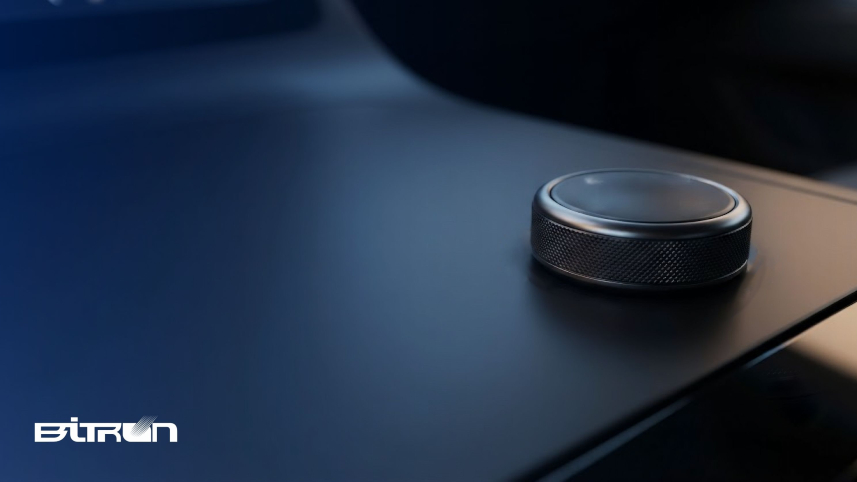
The Bitron Floating Knob is a patented automotive control interface that combines rotary and joystick functionality in a single control. While conventional joystick knobs require a small vertical displacement as they tilt during lateral movement, the Floating Knob achieves directional inputs without movement along the Z axis. This approach reduces packaging constraints beneath the control and gives OEMs greater flexibility when developing modern cockpit architectures.
Vehicle interiors have changed dramatically over the last decade. Material quality has become a key differentiator. Controls are expected to feel intuitive while blending naturally into the overall design.
Yet one challenge remains largely invisible to the driver. Many control systems still influence the architecture of the cockpit itself. Designers may pursue clean, uninterrupted surfaces, but the mechanics of a component often define what is actually possible. The result is a constant balancing act between aesthetics, functionality and packaging.
Key Takeaways
- The Floating Knob combines rotary and joystick functionality in a single control.
- Directional inputs are achieved without vertical movement of the knob.
- No dedicated cavity beneath the control is required to accommodate a tilting mechanism.
- Vehicle manufacturers gain greater freedom in center console and cockpit design.
- Continuous interior surfaces become easier to achieve.
- The concept is protected by Italian patent application No. 102025121134.
Automotive Control Interface Design and the Hidden Impact of Mechanical Constraints
As we were saying, traditional joystick-based controls rely on a tilting movement to generate directional inputs: although the user perceives lateral movement, the mechanism also moves along the Z axis. From an engineering perspective, this is a proven and widely adopted solution. From a design perspective, it introduces limitations.
The mechanism requires additional clearance beneath the visible surface, often leading to recessed areas or structural accommodations below the control. As vehicle interiors become cleaner and more integrated, these constraints become harder to ignore.
A designer may envision a continuous console surface. An engineer must ensure the control can move freely. Somewhere between those two requirements, compromises emerge.
Automotive Control Interface Design for Continuous Surfaces
Premium interior design increasingly favors simplicity. This does means reducing visual complexity while maintaining accessibility and intuitive control.
Compare the center console of a premium vehicle launched fifteen years ago with a recent EV platform. The number of visible controls has been reduced significantly, while expectations for functionality have remained unchanged.
Consumers rarely notice the engineering hidden beneath a center console. They do notice visual interruptions, unnecessary gaps and controls that break the continuity of a surface.
On the other side, for OEMs, surface continuity influences perceived quality, brand identity, material selection and the overall experience of the cockpit. Every component integrated into that surface either expands or limits the designer's options.
A Requirement That Challenged Existing Solutions
The origin of the Floating Knob started with a specific customer requirement. During the development phase, Bitron was challenged with a specific customer requirement: reducing the vertical movement of a control knob as much as possible, ideally eliminating it altogether.
That requirement raised a practical engineering question. Traditional joystick knobs already provide lateral inputs, but they typically achieve them through a tilting mechanism. Even a small inclination introduces movement along the Z axis and creates packaging requirements beneath the visible surface.
The challenge was to preserve the familiar user interaction while removing the vertical displacement traditionally associated with it.
Looking at the Problem Differently
The development team focused on a simple question: If the user's input is lateral, why should the knob need to move vertically at all?
Conventional joystick knobs move sideways from the user's perspective, but internally this movement is typically achieved through a tilting mechanism that also requires displacement along the Z axis. The Floating Knob approaches the same interaction differently.
Using a system based on torsion bars arranged in a dedicated configuration, the knob can move laterally without tilting. The directional input remains familiar from the user's perspective, while the vertical displacement is eliminated.
This changes the requirements beneath the visible interface and creates new possibilities for cockpit integration.
Floating Knob vs Traditional Joystick Controls
| Feature | Traditional Joystick Knob | Bitron Floating Knob |
| Rotary input | Yes | Yes |
| Joystick functionality | Yes | Yes |
| Lateral movement (XY) | Yes | Yes |
| Vertical movement | Required due to tilting | Not required |
| Under-surface cavity | Typically required | Reduced or eliminated |
| Surface continuity | More constrained | Greater design flexibility |
| Premium interior integration | Standard approach | Supports cleaner surface architectures |
Automotive Control Interface Design Through a New Motion Concept
Removing vertical movement creates opportunities that extend beyond the component itself.
Consider a center console covered by a continuous decorative surface. A conventional joystick knob requires additional space below the interface to accommodate its movement. Reducing or eliminating that requirement gives designers greater freedom when defining materials, layouts, lighting elements and neighboring components.
The benefit is not limited to packaging: the movement itself changes the visual perception of the control. Rather than appearing to pivot around a fixed point, the knob seems to glide across the surface. The effect is subtle, but it contributes to a cleaner and more refined appearance.
This change influences more than the component itself. It affects the way the surrounding surface is perceived, supports a more cohesive interior design language, and reduces some of the compromises traditionally associated with integrating directional controls into the cockpit.
Potential Applications
The Floating Knob can be integrated wherever vehicle functions benefit from a combination of rotary and directional inputs.
Examples include:
- Infotainment control systems
- Menu navigation interfaces
- Drive mode and vehicle setting selectors
In these applications, the objective is to integrate physical interaction into increasingly refined cockpit environments without forcing compromises elsewhere in the design.
A Physical Interface for Modern Cockpits
Predictions about fully touch-based interiors have existed for years. Yet physical controls continue to play an important role, particularly for functions that benefit from tactile feedback and intuitive operation.
The challenge is integrating those controls without disrupting the surrounding design: the Floating Knob was developed with that balance in mind. A single interface combines rotary input and directional control while maintaining the visual simplicity expected in contemporary vehicle interiors. As cockpit architectures continue to evolve, automotive control interface design is becoming as much about integration as interaction.
Ready for Additional Interaction Layers
The architecture behind the Floating Knob also leaves room for future developments.
A touch-sensitive panel can be integrated above the knob to detect hand or finger inputs and support additional functions.
This opens the possibility of combining mechanical control, directional inputs and touch interaction within the same interface while maintaining a consistent design language across the cockpit.
Automotive Control Interface Design Protected by Patent
The Floating Knob concept is protected by Italian patent application No. 102025121134.
The idea emerged from a specific design requirement: retaining the familiar interaction of a joystick control while eliminating the vertical movement traditionally associated with it.
Achieving that objective required rethinking the mechanism behind the control. Rather than introducing entirely new technologies, the development team focused on combining well-established engineering principles in a different way, ultimately creating a solution capable of delivering lateral inputs without tilt.
What began as an integration challenge became a new way of approaching the relationship between control interfaces and interior design.
Exploring New Approaches to HMI Integration?
Bitron works with OEMs and Tier 1 suppliers to develop control interfaces tailored to evolving cockpit architectures and user experience requirements.
Get in touch with our team to discuss future HMI concepts and integration opportunities.
Frequently Asked Questions
What is a Floating Knob?
A Floating Knob is a control interface that combines rotary and joystick functionality in a single component. Unlike traditional joystick knobs, it does not require the vertical displacement generated by a tilting mechanism.
How does the Floating Knob work?
Traditional joystick knobs achieve directional inputs by tilting, which introduces movement along the Z axis. The Floating Knob uses a dedicated torsion-bar architecture that allows lateral movement without tilting.
Why is eliminating vertical movement important?
Removing vertical displacement reduces the packaging space required beneath the control. This supports cleaner interior architectures and allows greater flexibility when designing center consoles and cockpit surfaces.
What are the benefits for automotive interior design?
The approach enables more continuous surfaces, fewer visible interruptions, greater freedom in component integration and a more refined visual appearance for the control itself.
Can additional functions be integrated into the Floating Knob?
Yes. The architecture can accommodate a touch-sensitive panel above the knob, enabling hand and finger recognition for additional commands and interactions.
Is the Floating Knob protected by a patent?
Yes. The concept is protected by Italian patent application No. 102025121134.
Transparency Notice
This article was prepared with the support of artificial intelligence tools. Technical information, product specifications and final editorial review were provided and validated by Bitron Corporate Communication & Automotive’s engineering teams. AI-generated visualization based on Bitron concept design.